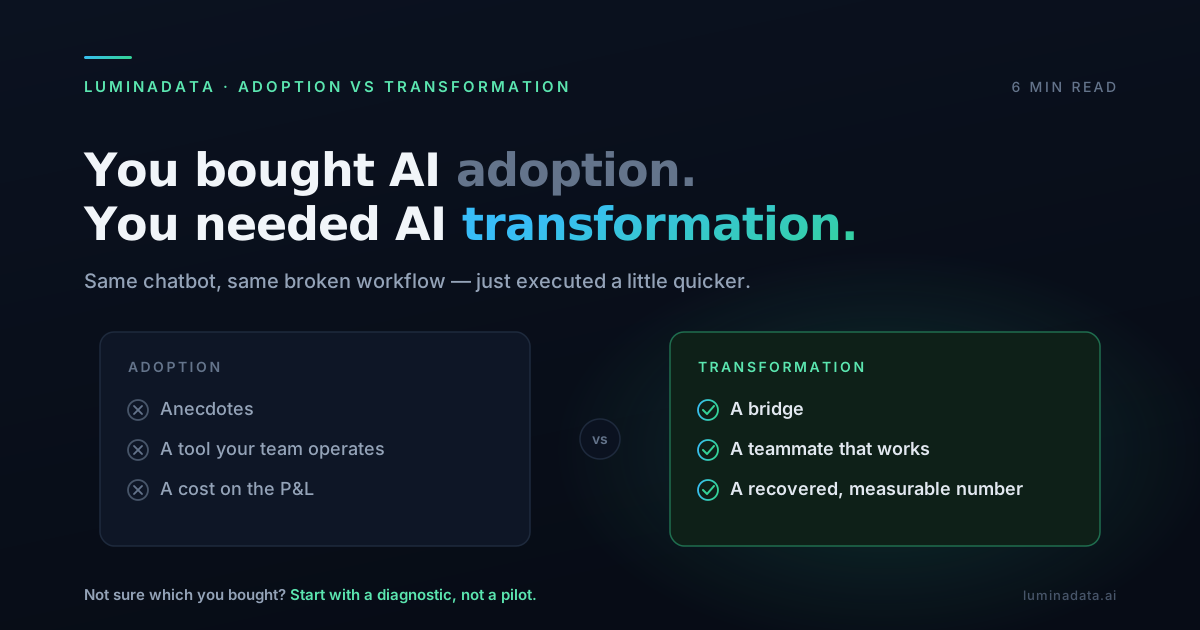
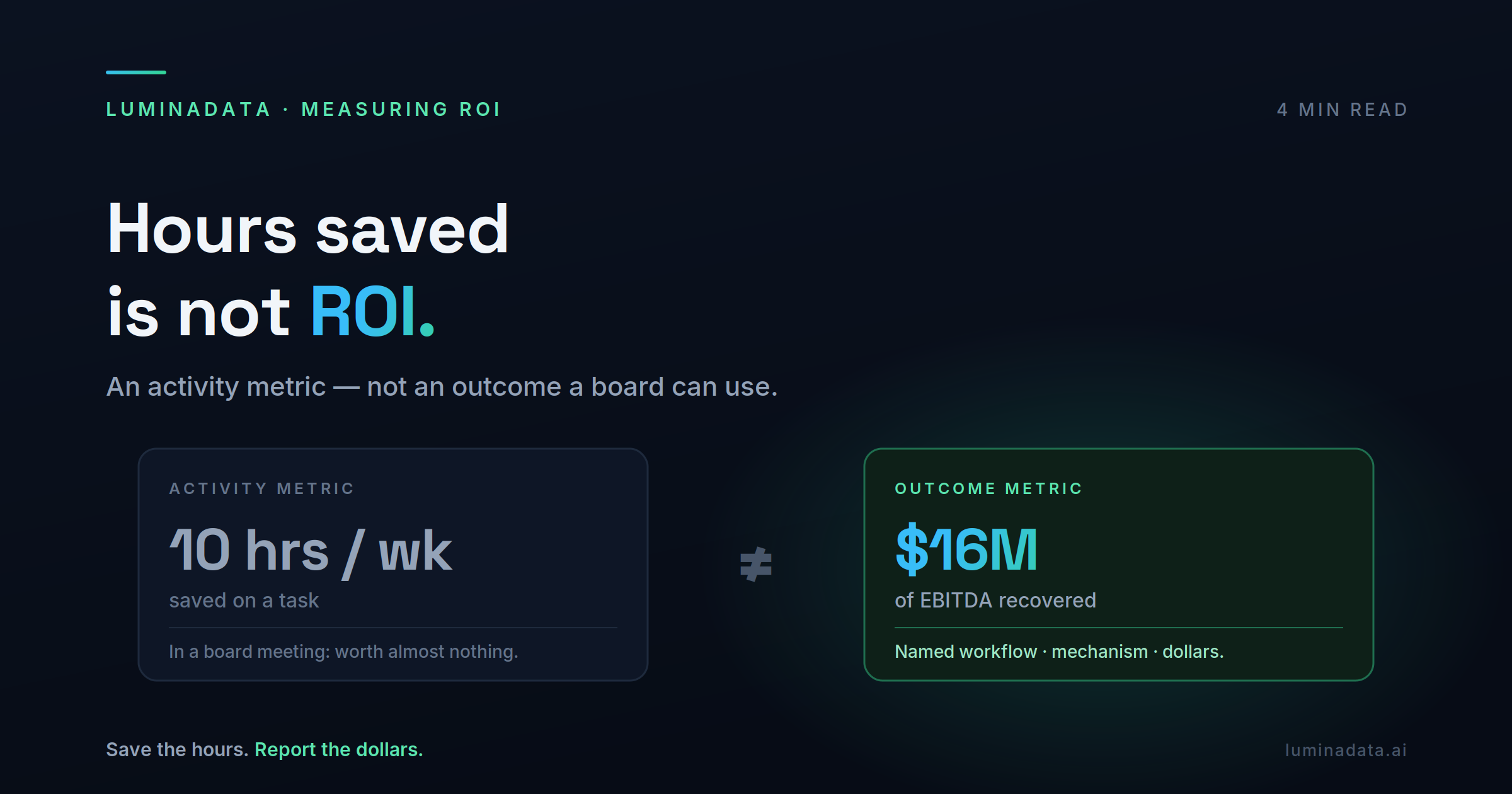
Ask a finance team how their AI pilot went and you will usually hear a number of hours. "It saves the team ten hours a week." It sounds like progress. In a board meeting, it is worth almost nothing.
Hours saved is an activity metric. EBITDA is an outcome metric. The gap between them is where most finance AI programs lose the plot.
The problem with hours
Hours saved on a task does not become money unless something changes: a role goes unfilled, capacity gets redeployed to work that was not getting done, or a cost actually leaves the P&L. Absent that, "ten hours a week" is ten hours your team now spends on something else — possibly something that also should not exist.
Hours saved on a task that shouldn't exist is not ROI. It is a faster way to do the wrong thing.
Boards buy outcomes
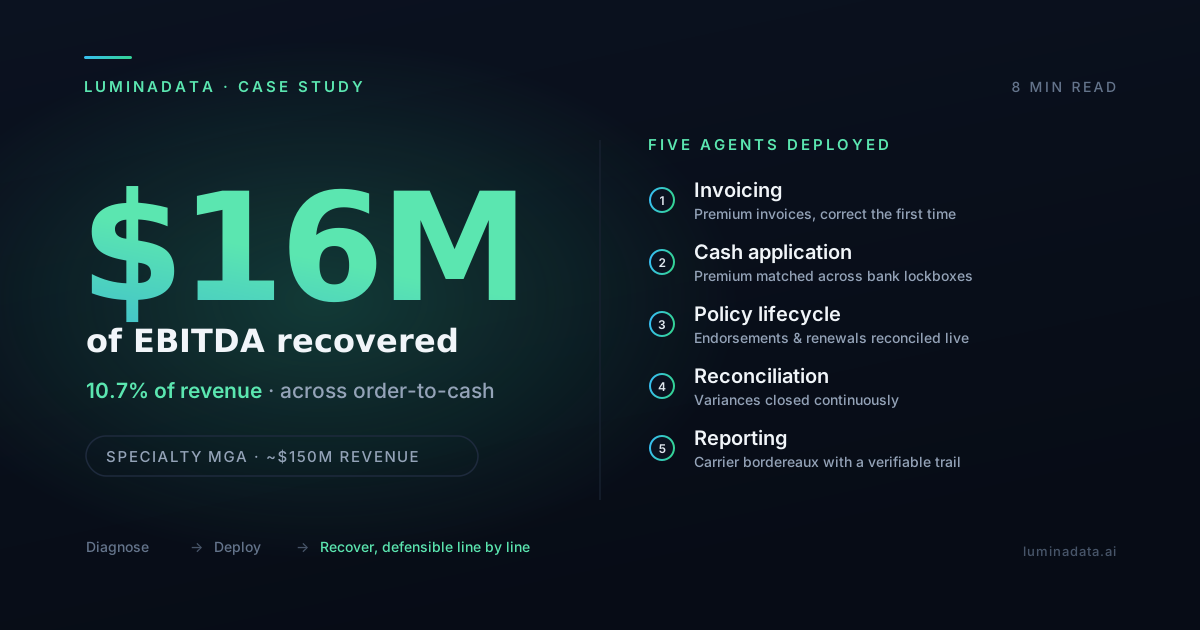
A CFO cannot take "the team likes it" to a board. They can take "we recovered $16M, here is the bridge." The difference is not spin — it is whether the result is tied to a financial statement. A defensible number names the workflow, the mechanism, and the dollars: recovered revenue here, avoided write-offs there, a role not backfilled there.
That is a higher bar than counting hours, and it should be. It is also what separates a transformation from a productivity anecdote.
How to measure it instead
Before you automate, quantify the opportunity in EBITDA terms and rank it. After you deploy, measure against that baseline — not against a vague sense that things feel faster. The point of a diagnostic is to make this possible: a number you projected, then captured, that moves on a statement your board already reads.
Save the hours, by all means. But report the dollars.